
By Aditya Pratap, Advocate and Founder, Aditya Pratap Law Offices, Mumbai.
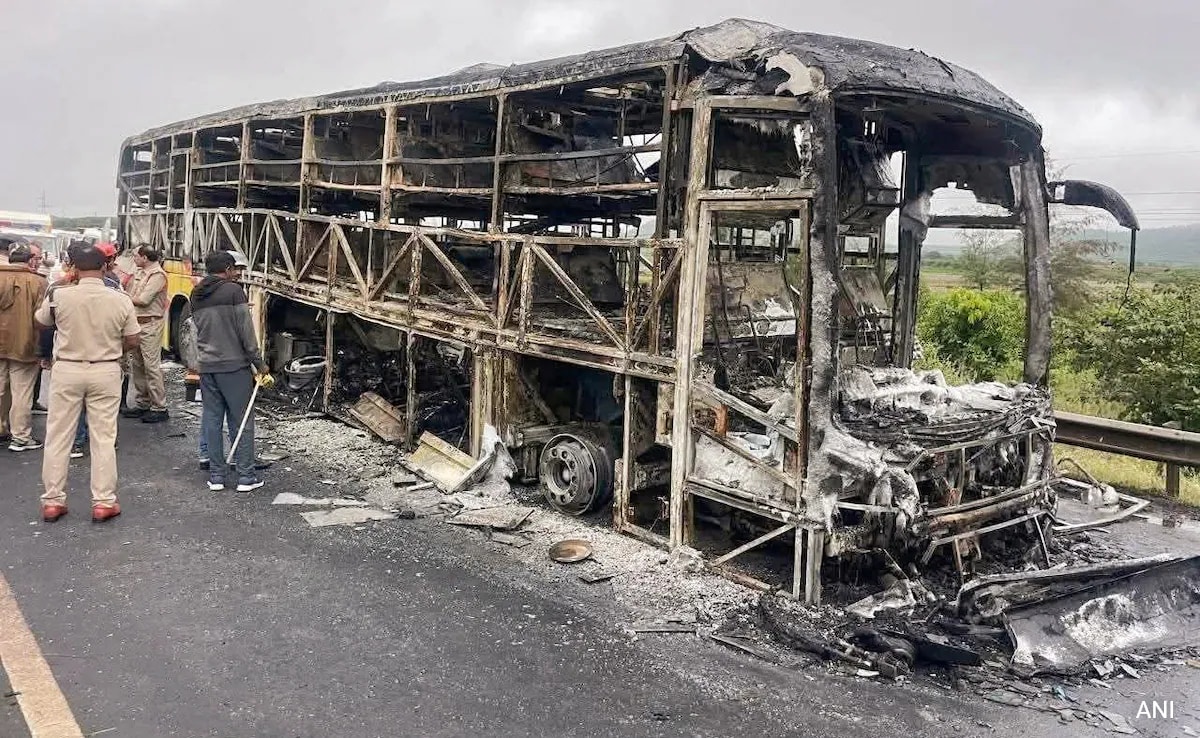
A private bus operated by Kaveri Travels caught fire in Andhra Pradesh’s Kurnool district while traveling from Hyderabad to Bengaluru. The incident killed at least 20 of the 41 passengers aboard.
The fire was caused when the bus hit a motorcycle on the highway, trapping the two-wheeler and rupturing the bus’s fuel tank, which led to an immediate explosion. The rapid spread of flames gave sleeping passengers little time to escape, though 21 people, including the drivers, survived.
Authorities have identified 11 of the deceased passengers, and efforts are ongoing to identify the remaining nine victims. The District Collector confirmed these details regarding the recovery and identification process.
Causes of the Fire – Ignition of Petrol from the Bike’s Fuel Tank
The collision caused the motorcycle to become trapped under the bus, directly impacting the bus’s own fuel tank. This impact ruptured the tank, and the resulting spray of diesel, combined with the petrol from the motorcycle’s smaller tank, was likely ignited by a spark from the grinding metal or the motorcycle’s engine, causing an immediate and violent explosion.
Sleeping Passengers Worst Affected
The explosion and rapid spread of flames occurred while many passengers were asleep, giving them no warning to react. Furthermore, the absence of a functional alarm system within the bus meant there was no audible alert to wake and direct them, trapping them in the engulfed vehicle before they could reach the exits.
The sleeping passengers were tragically the most vulnerable, as the state of unconsciousness delayed their recognition of the imminent danger. By the time they awoke to the chaos, the explosion and rapidly spreading flames had already sealed their escape routes, leaving them with little to no time to react before being overcome by the fire.
Registration of FIR and Police Investigation
Given this tragedy of monumental proportions, it is incumbent upon the local Police Station to register an FIR under Sections 106(1) and 112 of the Bhartiya Nyaya Sanhita, 2023. Section 106(1) applies to causing death by negligence. Section 112 of the BNS pertains to causing hurt by endangering life or personal safety of others.
Violations of the Motor Vehicles Act of 1988 and Rules made Thereunder
The shocking manner in which flames spread throughout the bus and engulfed the lives of passengers lays bare the blatant violations of the Motor Vehicles Act, 1988, and the rules framed under it. Such violations can be summarized as follows:
- Violation of Fitness Certificate Conditions (Section 56):
Every commercial vehicle must hold a valid Fitness Certificate issued by the Regional Transport Office (RTO), confirming it is roadworthy. The explosive fire, potentially linked to a vulnerable fuel tank, strongly indicates a critical failure in the vehicle’s safety systems and structural integrity. This would be a direct violation of the fitness standards, which can lead to the suspension or cancellation of the certificate, alongside hefty penalties. - Violation of Contract Carriage Permit Conditions (Section 74 & 84):
The bus was operating as a “contract carriage” (a bus hired for a specific trip/group). Its permit is granted under strict conditions regarding safety equipment. The apparent lack of functional fire safety equipment, such as fire extinguishers and, crucially, a passenger alarm system, constitutes a major breach of these permit conditions. This violation alone could lead to the suspension or cancellation of the operator’s permit. - Violation of Central Motor Vehicles Rules (CMVR) on Safety Equipment:
The Central Motor Vehicles Rules mandate specific safety features for sleeper coaches and contract carriages. These rules require a specified number of fire extinguishers, a first-aid kit, and hammers to break windows. The fact that passengers were trapped and unable to escape suggests a failure of these emergency systems. The absence of an alarm to alert sleeping passengers is a particularly egregious safety failure that violates these mandated standards. - Liability for Third-Party Insurance (Section 147):
While the bus would have mandatory third-party insurance, the insurer may contest the claim citing the operator’s fundamental violations—operating an un-roadworthy vehicle and failing to maintain basic safety standards. This could lead to protracted legal battles, though the ultimate liability to compensate the victims’ families and the injured, as per the “no-fault liability” principle under Section 140, remains.
Once again, the Spotlight on Corruption and Lax Road and Vehicular Safety Standards Returns
This tragedy is a grim reminder that systemic failures—from the alleged rubber-stamping of fitness certificates to the blatant absence of mandatory safety features like passenger alarms—continue to cost innocent lives. Until stringent regulations are enforced without exception and accountability is fixed on negligent operators and complacent officials, such horrific incidents will remain a recurring national shame.
Aditya Pratap is a lawyer practicing at the Bombay High Court. He is the founder of Aditya Pratap Law Offices, a multi-expertise law firm with offices at Nariman Point in Mumbai. His website is adityapratap.in and email is aditya@adityapratap.com.